
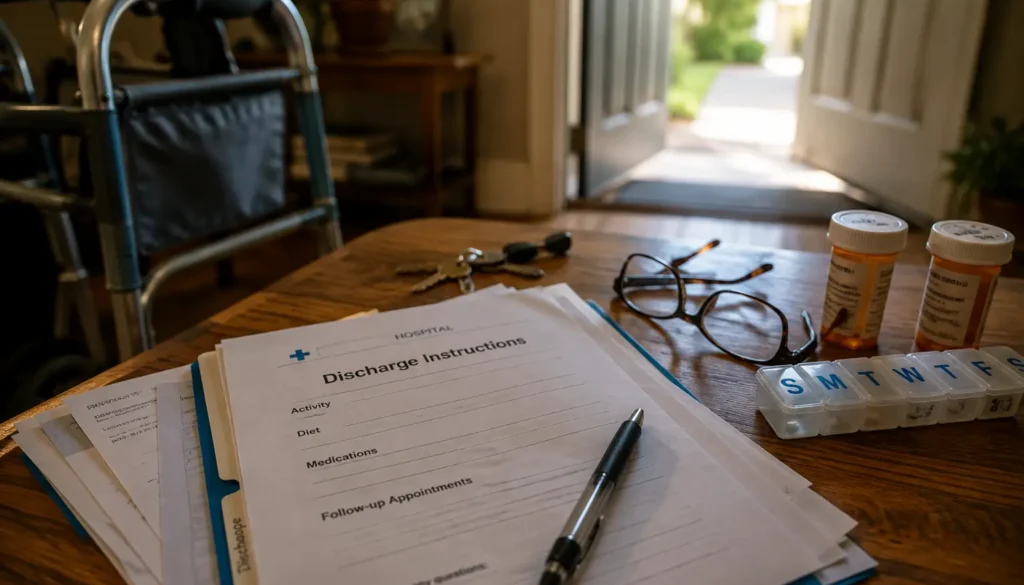
The Hospital Says Your Loved One Is Ready to Go Home. Now What? A Guide to Hospital Discharge Planning for Families
A hospital discharge should feel like good news.
Your parent, spouse, or loved one is stable enough to leave. Everyone is relieved. There is talk about going home, getting back into a routine, and finally sleeping in a familiar bed again.
Then someone says:
“They’re being discharged tomorrow.”
And suddenly the relief turns into a list of questions.
Who is picking them up?
What medications changed?
Do they need a walker, hospital bed, oxygen, or other equipment?
Who is scheduling the follow-up appointments?
Can they safely get to the bathroom alone?
Who will be there tonight?
What happens if something goes wrong?
For many families, the transition from hospital or rehabilitation care back home is one of the moments when caregiving becomes significantly more complicated.
The hospital stay may be ending.
The family’s work may just be beginning.
That is why hospital discharge planning matters.
A thoughtful discharge plan helps families understand what their loved one will need after leaving the hospital, who will be responsible for each part of the plan, and what support should be in place before everyone arrives home.
Quick Answer: What Is Hospital Discharge Planning?
Hospital discharge planning is the process of preparing a patient and their caregivers for the transition from a hospital, rehabilitation facility, nursing facility, or other care setting to the next level of care.
That next step may be:
- Returning home independently
- Returning home with family support
- Receiving home health services
- Receiving private-duty or in-home care
- Moving temporarily to a rehabilitation facility
- Transitioning to assisted living
- Transitioning to memory care
- Moving to another skilled-care setting
The goal is not simply to decide where someone is going.
The goal is to determine what the person will need to remain as safe, stable, and supported as possible once they get there.
Medicare provides a helpful discharge planning checklist for patients and caregivers that encourages families to review medications, warning signs, follow-up care, equipment needs, and who to contact with questions after discharge.
Why Hospital Discharge Can Feel So Overwhelming
Hospital stays move quickly.
A family may spend days worrying about test results, procedures, infections, falls, or whether a loved one is getting better.
During that time, someone else is handling meals, medications, mobility, vital signs, transportation, and medical monitoring.
Then discharge arrives.
The structure disappears.
Mom may be medically stable enough to leave the hospital but still need help getting dressed.
Dad may be able to walk down the hospital hallway with assistance but not safely navigate the stairs at home.
A spouse may understand the medication instructions while sitting with the nurse but feel completely unsure once there are 11 bottles sitting on the kitchen counter.
None of this means the discharge was inappropriate.
It means that medical stability and everyday independence are not the same thing.
The National Institute on Aging’s guidance on hospitals and hospitalization explains that hospital stays can be stressful for older adults and their families, making preparation, communication, and follow-up especially important.
What Should Families Ask Before a Loved One Leaves the Hospital?
Families should not be afraid to ask questions.
In fact, this is one of the most important times to ask them.
Before discharge, make sure someone understands the answers to the following.
What Changed Medically?
Ask:
- What diagnosis was made?
- What treatment was provided?
- What symptoms should improve?
- What symptoms may continue?
- What complications should we watch for?
- What would require a call to the doctor?
- What would require returning to the emergency room?
Write the answers down.
Do not rely on remembering everything later.
What Medications Changed?
Medication changes are common during hospitalization.
Before leaving, make sure you understand:
- Which medications were added
- Which medications were stopped
- Whether any dosages changed
- When each medication should be taken
- What side effects to watch for
- Whether prescriptions have already been sent to the pharmacy
Medicare’s discharge planning checklist specifically encourages patients and caregivers to review the complete medication list and understand any changes before leaving a care setting.
What Follow-Up Appointments Are Needed?
Ask:
- Which doctors need to be seen?
- How soon should appointments occur?
- Are any laboratory tests needed?
- Is physical, occupational, or speech therapy recommended?
- Who is responsible for scheduling each appointment?
“Follow up with your doctor” can sound simple until the family gets home and realizes nobody knows which doctor, when, or why.
What Can the Person Safely Do at Home?
Ask specifically about:
- Walking
- Stairs
- Bathing
- Dressing
- Toileting
- Meal preparation
- Driving
- Lifting
- Wound care
- Medication management
If the person needs assistance with these tasks, determine who will actually provide it.
“We’ll figure it out” is not a care plan.
Is the Home Actually Ready?
Sometimes the medical plan makes sense while the home does not.
Before discharge, look at the environment your loved one is returning to.
Can they safely enter the house?
Are there stairs?
Is the bedroom upstairs?
Can they get into the shower?
Are there rugs or other fall hazards?
Is the bathroom accessible?
Can they prepare food?
Can they get to the toilet quickly and safely?
Is someone available overnight?
A few small changes may be enough.
Other situations may require equipment, home-care support, temporary rehabilitation, or a conversation about whether returning home is really the safest immediate option.
This is exactly where an outside care professional can help a family look at the situation more objectively.
Who Is Actually Responsible After Discharge?
This is a question families often do not ask until they are already home.
One sibling assumes another sibling is managing medications.
A spouse assumes the home-health agency will handle everything.
The adult child who lives closest becomes the default person for appointments, groceries, transportation, and emergencies.
No one ever formally decided that.
It just happened.
Before discharge, identify:
- Who is the main family contact?
- Who is managing medications?
- Who is scheduling appointments?
- Who is handling transportation?
- Who is checking in during the day?
- Who can help overnight?
- Who will communicate with doctors?
- Who will coordinate outside services?
The more specific the plan is, the less likely one caregiver is to quietly become responsible for everything.
What Does a Hospital Discharge Planner Do?
Hospitals commonly have nurses, social workers, case managers, or other qualified professionals involved in discharge planning.
Their role may include helping the patient and family understand the next level of care, coordinating referrals, identifying post-acute services, and making sure relevant medical information follows the patient.
Federal discharge-planning requirements emphasize that patients and caregivers should be active participants in planning for post-discharge care and that the patient’s goals and treatment preferences should be considered.
Hospital discharge planning is important.
But families should also understand something else:
Hospital discharge planning usually focuses on getting the patient safely from one care setting to the next.
The family may still need substantial help once that transition occurs.
That is where ongoing care coordination can become valuable.
What Happens After the Hospital’s Discharge Plan Ends?
The family gets home.
The discharge packet goes on the counter.
Then real life starts.
Maybe the pharmacy does not have one of the prescriptions.
Mom refuses to use the walker.
Dad cannot remember which medication he already took.
The follow-up specialist has no appointments for three weeks.
One sibling wants home care.
Another thinks assisted living should be considered.
The person who promised to stay overnight suddenly cannot.
These are not unusual situations.
They are exactly why care coordination often extends far beyond the day someone leaves the hospital.
How GuideWISE Helps Families After a Hospital or Rehabilitation Stay
GuideWISE supports families who are trying to turn a medical discharge plan into a realistic everyday care plan.
Care is provided by experienced licensed social workers who understand the medical, emotional, and practical challenges families face while navigating aging, illness, disability, and major life transitions.
GuideWISE services may include:
Comprehensive Care Assessments
A family may know something has changed without fully understanding how much support is now needed.
A comprehensive assessment can help look at the whole situation, including:
- Functional abilities
- Safety concerns
- Current care
- Family availability
- Medical needs
- Living environment
- Social support
- Changing cognitive needs
That gives families a clearer starting point.
Personalized Care Planning
There is no single discharge plan that works for every family.
Some people may need temporary support while recovering.
Others may be entering a long-term change in independence.
GuideWISE helps families create a plan based on the loved one’s actual needs, preferences, family resources, and goals.
Medical Advocacy
Medical appointments can become complicated quickly when multiple diagnoses, specialists, medications, and family members are involved.
GuideWISE can help families prepare questions, attend appointments when appropriate, communicate with providers, and make sure important concerns are not lost in the shuffle.
Appointment Coordination
One hospital stay can generate several follow-up appointments.
GuideWISE can help organize those appointments and the follow-up tasks connected to them so families are not trying to manage everything from memory.
In-Home Care Coordination
If a loved one needs additional support at home, families may suddenly find themselves trying to understand the difference between home health, private-duty care, personal care, therapy, and other services.
GuideWISE helps families understand options and coordinate appropriate resources.
Senior Living and Memory Care Guidance
Sometimes a hospital or rehabilitation stay reveals that the previous living arrangement may no longer be working.
GuideWISE can help families explore senior living and memory-care options based on the individual’s needs rather than simply handing the family a list of facilities.
Family Meetings and Care Conferences
Care decisions become harder when everyone sees the situation differently.
GuideWISE can help facilitate conversations so siblings, spouses, adult children, and other involved family members can better understand the current needs and available options.
Ongoing Care Coordination
Needs do not stop changing after discharge.
GuideWISE can remain involved as circumstances evolve, helping families adjust the care plan rather than starting from scratch every time something changes.
Care Coordination Is Different From a Referral List
A referral can be useful.
Sometimes families simply need the name of a home-care provider, rehabilitation facility, or senior living community.
But many situations are more complicated than that.
The family may not know which service they need.
They may not know whether home is still safe.
They may be comparing several care options while also dealing with medical appointments, insurance questions, family disagreements, and an exhausted primary caregiver.
GuideWISE is designed to remain involved in the process.
The goal is not simply to say, “Here are three providers. Good luck.”
It is to help the family understand the problem, evaluate options, coordinate next steps, advocate when necessary, and adjust the plan as needs change.
When Should a Family Consider Professional Care Coordination?
You do not have to wait until everyone is completely overwhelmed.
Professional care coordination may be helpful when:
- A loved one is being discharged from a hospital or rehabilitation facility
- There have been repeated hospitalizations
- Memory loss is becoming more noticeable
- Medications or appointments are becoming difficult to manage
- A parent can no longer safely live completely independently
- Family members disagree about what should happen next
- The primary caregiver is exhausted
- Adult children live far away
- Assisted living or memory care may need to be considered
- Multiple doctors and providers are involved
- The family understands the medical problem but does not know how to manage the day-to-day reality
Sometimes the clearest sign is simply this:
Everyone is trying very hard, and the situation still feels unmanageable.
What If My Loved One Has Dementia?
Hospitalization can be particularly difficult for someone experiencing dementia or significant memory loss.
Changes in routine, unfamiliar environments, illness, medications, and sleep disruption may increase confusion.
The National Institute on Aging provides specific information for families caring for a person with Alzheimer’s disease or another dementia during a hospital stay.
Before discharge, families should make sure the care plan reflects the person’s cognitive abilities—not simply their physical recovery.
Someone may technically be able to walk, eat, and dress while still being unable to safely manage medications, recognize emergencies, or remain alone for long periods.
These details matter.
What If We Do Not Agree With the Discharge Plan?
If you believe the proposed discharge is unsafe, speak up before leaving.
Ask to speak with the discharge planner, case manager, social worker, nurse, or physician.
Explain your concerns specifically.
For example:
- There is nobody available to provide the required level of care.
- The person cannot safely enter or move around the home.
- Necessary equipment has not arrived.
- Required medications are unavailable.
- The family has not been trained to perform required care.
- The patient’s cognitive limitations have not been adequately considered.
Medicare hospital inpatients receive information about their rights through the Important Message from Medicare, including information about discharge appeal rights.
Families whose Medicare-covered services are ending may also receive notices explaining their rights. CMS maintains current information about Medicare notices related to the end of covered services.
If you believe Medicare-covered services are ending too soon, CMS also provides information on how to appeal when Medicare-covered services are ending.
Families should ask questions until they understand both the discharge plan and the options available to them.
Frequently Asked Questions About Hospital Discharge Planning
Q: What is hospital discharge planning?
Hospital discharge planning is the process of preparing a patient to safely transition from a hospital or other care facility to the next care setting.
It should address medical needs, medications, follow-up care, equipment, services, caregiver availability, safety concerns, and the patient’s goals and preferences.
Q: When should discharge planning begin?
Ideally, discharge planning begins before the actual day of discharge.
Families should begin asking questions as soon as it becomes clear that the patient may soon transition home, to rehabilitation, to skilled nursing, or to another care setting.
Q: Who should be involved in hospital discharge planning?
The patient should be involved whenever possible, along with the family member, caregiver, or representative who will help provide care after discharge.
Hospital staff may include nurses, physicians, social workers, case managers, therapists, and other professionals.
Q: What should I bring home from the hospital?
Before leaving, make sure you have the discharge instructions, current medication list, prescriptions, follow-up information, contact numbers, equipment instructions, and clear guidance about symptoms or complications that require medical attention.
Q: What if my parent cannot safely be alone after discharge?
Tell the discharge team before leaving.
The family may need to consider home-care services, family coverage, rehabilitation, skilled nursing, assisted living, or another arrangement depending on the person’s condition and needs.
Do not assume someone will “figure it out” once you arrive home.
Q: Can GuideWISE attend medical appointments?
GuideWISE provides medical advocacy and can help families prepare for and navigate appointments. Depending on the family’s needs and service arrangement, support may include attending appointments and helping ensure important questions and concerns are addressed.
Q: Can GuideWISE help after a rehabilitation stay?
Yes.
The same challenges can arise when someone transitions from rehabilitation back home or to another care setting.
GuideWISE can help families assess current needs, coordinate services, plan appointments, navigate living options, and adjust the plan as recovery progresses.
Q: Can GuideWISE help us find assisted living or memory care?
Yes.
Senior living and memory-care navigation are among the services GuideWISE provides.
The goal is to understand the individual’s needs and help identify appropriate options rather than simply provide a generic facility list.
Q: Is GuideWISE a home-care agency?
No.
GuideWISE provides professional care coordination, advocacy, assessments, navigation, and family support.
When hands-on home care or another direct service is needed, GuideWISE can help families understand and coordinate appropriate resources.
Q: Is care coordination only for older adults?
No.
Care coordination may also be useful for families supporting adults with chronic illness, disability, complex medical needs, or major life transitions.
Q: What if my siblings and I disagree about what our parent needs?
That is common.
Family members may have different levels of involvement and may be seeing very different parts of the situation.
A neutral professional can help the family better understand the loved one’s needs, available options, and the practical realities of each potential plan.
Q: How long does care coordination last?
That depends on the family.
Some families need help navigating a specific transition.
Others benefit from ongoing support as medical, cognitive, or living needs continue to change.
GuideWISE offers both structured care-coordination services and ongoing support based on the family’s needs.
The Hospital Stay May Be Ending. Your Family Does Not Have to Figure Out the Rest Alone.
Coming home from the hospital can be an enormous relief.
It can also be the moment a family realizes that life is not simply going back to the way it was before.
Your loved one may need more help.
The home may need to change.
Appointments may multiply.
The family may need to make decisions nobody expected to make yet.
You do not have to wait until everyone is exhausted before asking for support.
GuideWISE helps families bring structure to complicated care situations through professional assessment, advocacy, coordination, navigation, and ongoing support.
The goal is simple:
Help your loved one receive the right support while helping your family make informed decisions with greater confidence and peace of mind.
Learn More About GuideWISE
https://www.guidewisecare.com/
For questions about estate planning, legal authority, Powers of Attorney, long-term care planning, or other elder-law issues that may arise alongside a change in care needs, contact The Legacy Elder Law Center for a FREE consultation:
https://legacyelderlaw.com/contact/
GuideWISE is not a law firm. Legal services are provided separately through The Legacy Elder Law Center when appropriate. This article provides general educational information and is not medical or legal advice.